
4.1 Cyrus Wakefield: Father of the Wicker Industry
The industrial history of modern wicker began in the mid-19th century in the United States. Wicker furniture construction developed into an original American craft tradition starting early in that century. Cyrus Wakefield is recognized as the pivotal figure in this transition, often called the “Father of the Wicker Industry”. In the 1840s, Wakefield started the first significant rattan company in South Reading, Massachusetts.
Wakefield’s initial strategy involved trading imported raw rattan to existing basket and furniture manufacturers, who utilized the outer cane skin to weave seats and backs. However, in 1855, he established the Wakefield Rattan Company, moving beyond simple material trade and aggressively experimenting with furniture design. His innovation lay in hybridizing materials: he used bent hickory or oak to form strong, flowing structural frames, which were then wrapped and filled with intricate patterns woven from split cane and ornate rattan. By adapting pre-existing industrial technologies, such as wood-bending techniques common in chair manufacturing, Wakefield was able to construct the structural skeletons rapidly. This hybridization allowed for the mass production of highly complex, aesthetically detailed woven forms that were prohibitively slow and expensive to produce purely by hand-weaving traditional materials. By the time of his death in 1873, the Wakefield Rattan Company was a massive operation, employing 1,000 workers at an 11-acre site.
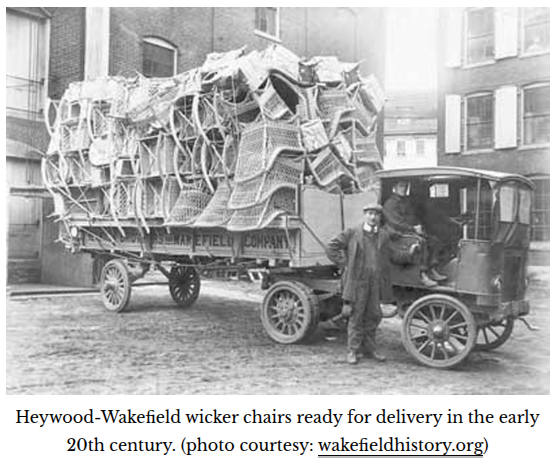
4.2 The Heywood-Wakefield Manufacturing Conglomerate
The industrial momentum in the US led to intense competition. The Wakefield Rattan Company’s primary rival was Heywood Brothers & Company. Recognizing the benefits of consolidation, the two major forces merged in 1897, forming the dominant Heywood-Wakefield Company. This conglomerate rapidly expanded, acquiring other furniture makers in the ensuing years, cementing its status as a major national manufacturer.
Heywood-Wakefield became the definitive purveyor of quality American Victorian furniture, frequently referred to as the “Rolls-Royce” of the genre. The complex’s manufacturing facilities, located in Gardner, Massachusetts, were recognized for their historical importance and were later added to the National Historic Register.
4.3 The Victorian Obsession: Aesthetics and Hygiene
Wicker reached its zenith in terms of sheer popularity and stylistic exuberance during the Golden Era of the Victorian Age, roughly spanning 1860 to 1880. The designs were characterized by their highly ornate, elaborate, and graceful styles.
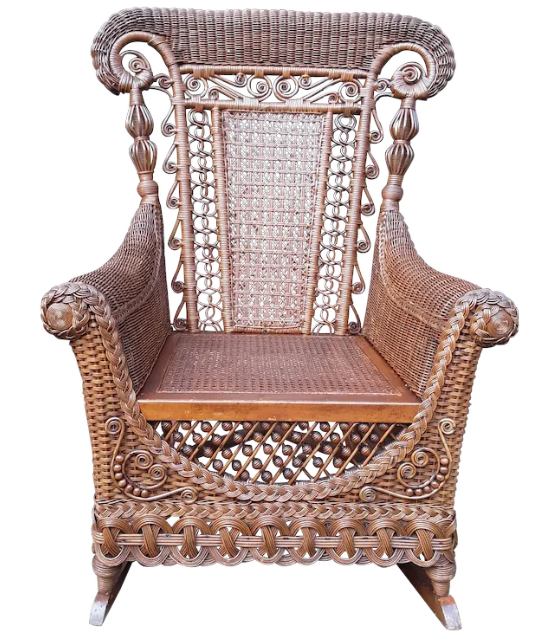
Antique Victorian Wicker Rocking Chair Rare Natural Rocker Circa 1890’s https://www.rubylane.com/item/679002-D2832/Antique-Victorian-Wicker-Rocking-Chair-Natural
However, the popularity of wicker during this period was driven by more than just aesthetics; it was fundamentally a response to contemporary public health and living considerations. Victorian consumers actively preferred rattan because they held the belief that it was “more sanitary than upholstered furniture”. In an age grappling with the realities of urban sanitation and lacking a full understanding of germ theory, furniture that did not harbor dust, moisture, and potential microscopic contaminants in dense upholstery held a strong functional appeal. Furthermore, wicker’s natural resistance to weathering and moisture made it an ideal, easily cleanable choice for the era’s increasingly popular sun porches, verandas, and outdoor settings. This acceptance into the Victorian home was, therefore, as much a practical and hygienic decision as it was a stylistic one.
Do you have rattan or rimepie furniture needing restoration? Contact me with a picture of the furniture in question for an estimate. Yes, it is an estimate because pictures don’t always tell the whole story, and once I see the actual piece, there may be other issues that also requires attention.
Get an estimate by using the contact form here (https://rattanandriempie.co.za/social-media) or the whatsapp at the left bottom corner of the page, or this link http://wa.me/27764989916.