
6.1 The Arts and Crafts Validation (Early 1900s)
Wicker demonstrated its versatility by seamlessly integrating into major 20th-century design movements, adapting its form while maintaining its core woven texture. In the early 1900s, the Arts and Crafts Movement spurred a notable revival of wicker.
This movement fundamentally rejected the over-ornamentation of mass-produced Victorian furniture. Wicker, utilizing natural materials like willow and rattan and showcasing the visible techniques of hand-weaving, naturally aligned with the Arts and Crafts ethos of valuing craftsmanship, simplicity, and natural functional form. This endorsement helped elevate wicker beyond mere Victorian fashion into a respected decorative and functional art.
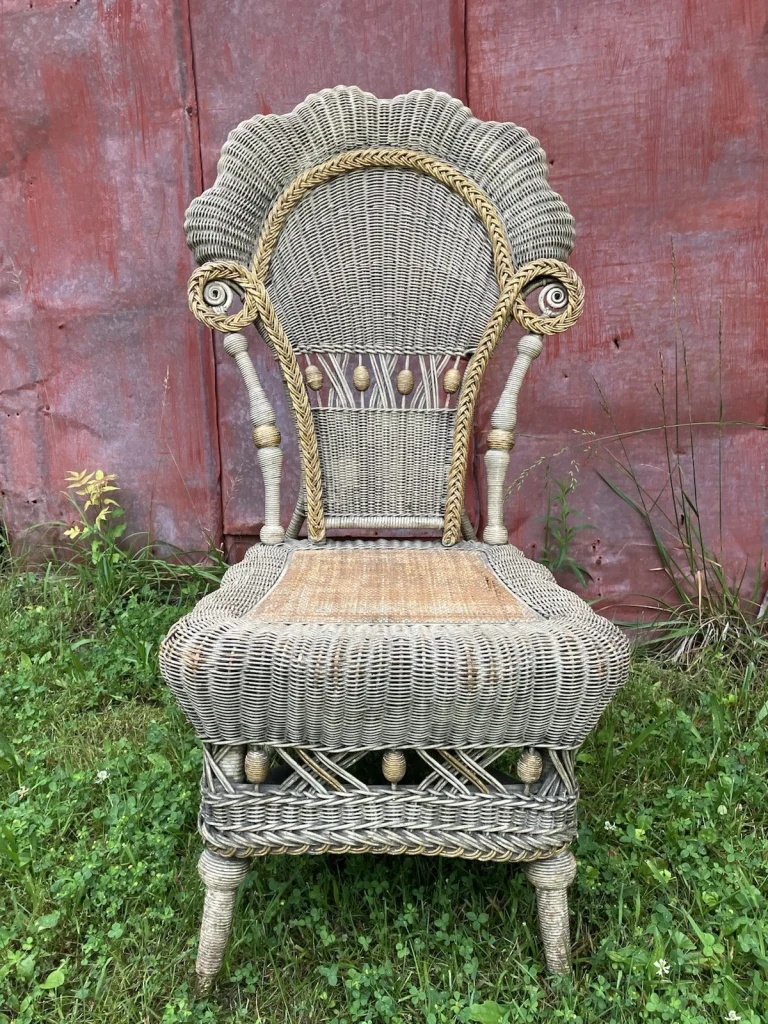
RARE WICKER Heywood Wakefield Brothers Wicker ALL ORIGINAL GOLD & CREAM Rattan
6.2 Rattan as Sculpture: Mid-Century Modernism
Perhaps the greatest formal challenge to wicker came from the Mid-Century Modern (MCM) movement, which demanded clean lines, organic shapes, and minimalist structures. Rather than rejecting the material, MCM designers embraced rattan’s unique properties to create some of the era’s most iconic and sculptural pieces.
Pioneering designers, including Nanna & Jørgen Ditzel, Arne Jacobsen, and the Italian architect Franco Albini, utilized rattan to create experimental shapes and sculptural, timeless icons. Albini, in particular, was lauded for incorporating rattan into his work in ways that balanced functionality with aesthetic beauty. A prime example is his Margherita armchair, which features a complex woven seat and backrest that allows the material to define the overall organic form.
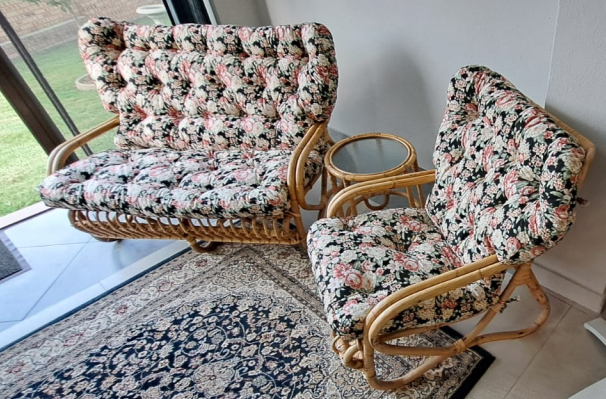
The material’s success in high modernism derived from its physical flexibility. Rattan allowed designers to achieve the biomorphic, organic curves essential to the post-war aesthetic, shapes that would have been costly, heavy, or structurally awkward if attempted in solid wood or metal. In MCM design, the woven surface texture and the structural element became unified, adhering perfectly to the Modernist ideal that form should follow the function and properties of the material itself.
6.3 The Enduring Appeal
The adaptability of the woven aesthetic is further demonstrated by the continuing market demand for classic designs. Decades after their initial merger, the Heywood-Wakefield Company, whose name is associated with both the highly ornate Victorian period and the streamlined Mid-Century Modern era, has continued to see demand for vintage styles. Companies have acquired rights to manufacture new pieces in the style of original Heywood-Wakefield furniture, illustrating that the fundamental comfort and appealing texture of wicker design maintain a consistent market value, irrespective of the fluctuating tides of high fashion