
5.1 Rattan Supply Crisis (World War I)
The global reliance on tropical rattan supplies proved vulnerable to geopolitical disruption. The outbreak of World War I created a severe crisis in the supply chain, dramatically restricting the availability of natural rattan for Western manufacturers. This material scarcity demanded an immediate and innovative solution to sustain the industry.
5.2 The Marshall B. Lloyd Breakthrough (1917)
The necessary innovation came from entrepreneur Marshall Burns Lloyd, a producer of baby strollers in the United States. In 1917, Lloyd addressed the material shortage by inventing a revolutionary manufacturing technique that substituted natural fiber with an engineered composite, which he named the Lloyd Loom.
The technique involved twisting strips of specialized paper around a fine metal wire core. This resulting composite material was then machine-woven into large, continuous sheets. The subsequent testing revealed key technical advantages: the Lloyd Loom material was not only significantly stronger than natural rattan, but also softer and far more comfortable. The embedded metal wire provided internal stability and shape memory, which solved common issues of natural fibers cracking or sagging over time. The standardization and mass-producibility of the woven sheets represented the first highly successful industrialized hybrid synthetic material in the history of wicker, removing the industry’s dependence on manual craftsmanship for weaving large surfaces.
5.3 Defining European Luxury and Leisure (1920s–1940s)
While invented in the United States, the Lloyd Loom technique reached its peak cultural expression in Europe. In 1922, William Lusty acquired the UK patent and began developing a unique line of furniture. This furniture quickly became the rage across the UK and Western Europe.
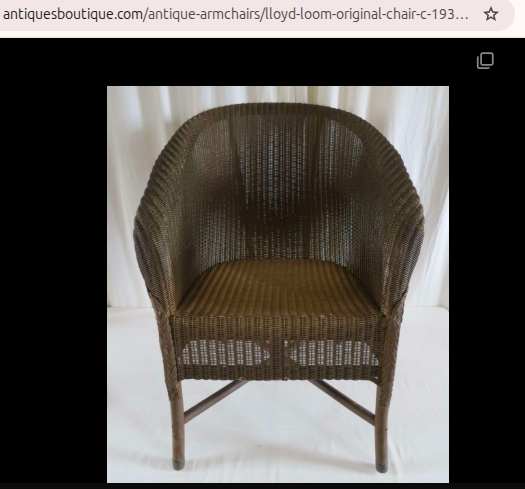
At the height of its success during the 1920s and 1930s, Lloyd Loom defined leisure and luxury. The furniture, recognized for its stylish, timeless curved frames and outstanding comfort, could be found in high-society venues, including restaurants and tea rooms. Significantly, it was adopted for use aboard prestigious, fast-moving transportation such as Zeppelin airships, ocean-going liners, and cruise ships. This adoption by transport designers signaled a shift in perception: the woven aesthetic was no longer associated solely with rustic or verandah settings, but with sophisticated, modern travel and durability. The material’s ability to resist cracking in dynamic environments, facilitated by the metal core, made it superior to traditional natural wicker for these demanding applications. Production continued successfully until the factory was bombed during World War II, effectively halting the initial phase of the industry.